IRANIAN GRAFFITI
Foto Exhibition, & Video Installation Nov 2016, Berlin
This installation grew from a body of pictures I made while traveling Iran back in 2014 & 2015 in Iran. In the meantime I added additional information on how both government & underground graffiti activities evolved post 2015 until today.
One of the central reasons the 1979 Islamic Revolution consolidated power so effectively was its systematic use of mass communication and visual propaganda. Alongside radio, posters, and print, walls became a broadcast medium: slogans, portraits, and symbols were scaled for the street—built to be repeated, reproduced, and seen by everyone.

During the revolutionary period leading up to 1979, Ayatollah Ruhollah Khomeini’s image circulated widely through decentralized street networks that included a broad spectrum of anti-Shah actors. Groups such as the People’s Mujahedin of Iran (MEK), alongside Islamist, leftist, student, and bazaar networks, made tactical use of Khomeini’s name and portrait as a unifying revolutionary symbol.
Khomeini’s portrait was reproduced through easily replicable formats — posters, traced templates, and high-contrast wall portraits — which functioned similarly to stencils even when painted with brushes or rollers. These simple reproduction techniques were disseminated informally, allowing ordinary people to replicate and spread his image on public walls. What remains visible today are the results: repeated, near-identical images that testify to a decentralized, participatory visual infrastructure.
After the revolution, once Khomeini consolidated power, rival revolutionary groups were rapidly eliminated, and street imagery was absorbed into a centralized state propaganda apparatus. What had briefly functioned as a plural, bottom-up visual language was transformed into an exclusive, state-controlled iconography, with independent or unsanctioned wall interventions becoming punishable offenses.

Even today, revolutionary and post revolutionary propaganda graffitis in full fledged pop colors can be found all over Iran. Some of them have faded away, some of them are being refurbished on a regular basis. Most of them stem from the 8 year Iran/Irak war, with fallen soldiers stylized as Martyrs. As opposed to many other countries where graffiti is an underground artform used as means of protest, usually illegal, the post revolutionary regime has occupied this artform for national propaganda.


Unlike many countries where graffiti primarily signals unsanctioned protest, in Iran the state itself has institutionalized wall painting as an instrument of power. Unsanctioned graffiti is treated not as minor vandalism but as political disobedience: artists often remain anonymous, work fast, and expect their pieces to be erased quickly; arrest can lead to prosecution under broad, politicized charges (reported examples include “disturbing public order” and other security-coded accusations), with serious penalties including imprisonment.


Defacing or removing state murals can trigger harsh consequences—because these murals function as curated ideological infrastructure, not merely decoration. The wall is treated less as public commons than as a managed state medium.


During and after the revolution, portraits of revolutionary figures—especially Ayatollah Khomeini—appeared widely in public space, often through easily reproducible formats such as posters and stenciled imagery. Archival material from the early post-revolutionary period documents public walls combining a Khomeini portrait with stencil work and handwritten slogans, showing how “print-like” techniques migrated onto the street and made visual messaging easier to replicate across neighborhoods.


More than four decades later, revolutionary and post-revolutionary propaganda murals still cover Iranian cities. Executed in bold, saturated colors and large figurative compositions, these works are typically not spontaneous. Some have faded; others are routinely restored or repainted. A major share stems from the eight-year Iran–Iraq War (1980–1988), where fallen soldiers are stylized as martyrs and woven into a state narrative of sacrifice, religious legitimacy, and national endurance.


Since the 2010s (and increasingly visible after 2015), official wall imagery has not remained static. In some cities, municipal “beautification” programs have pushed parts of the mural landscape toward less overtly military themes—national heritage, civic messaging, stylized design—while other districts continue to maintain highly ideological murals (including regularly restored anti-US slogans).


In parallel, a distinct street-art and graffiti scene has continued to develop—mixing Persian calligraphy with global graffiti styles, and often relying on small, quickly executed pieces (including black-and-white stencils) in less visible locations to survive longer before being painted over.
Unsanctioned graffiti is often removed within days, and artists risk prosecution under broad political charges rather than simple vandalism.
This “counter layer” became especially visible during periods of unrest. Reporting around the 2022 “Woman, Life, Freedom” uprising describes an ongoing cycle in which protest slogans and images are rapidly painted over by municipal workers or volunteers, only to reappear again—turning the wall into a contested surface rather than a stable artwork.


Here are links to other people have taken of Iranian post irslaic revolution state propaganda:
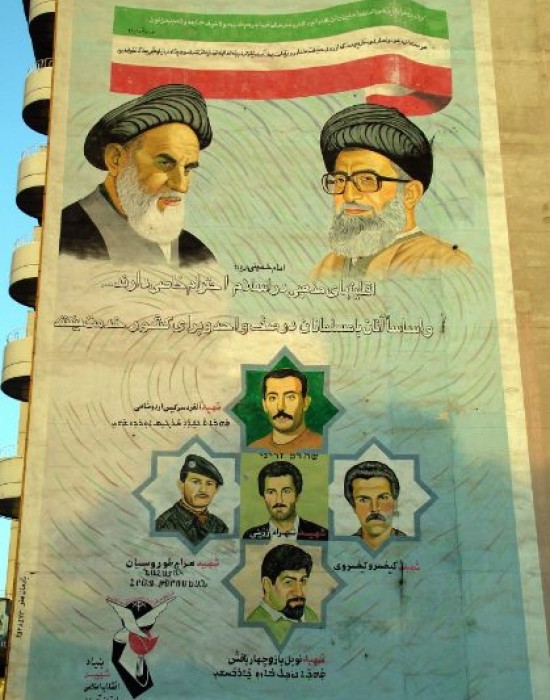


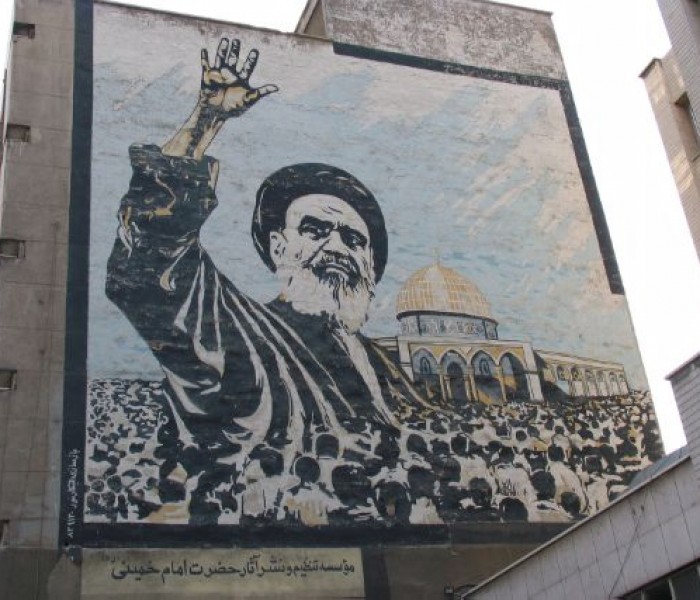

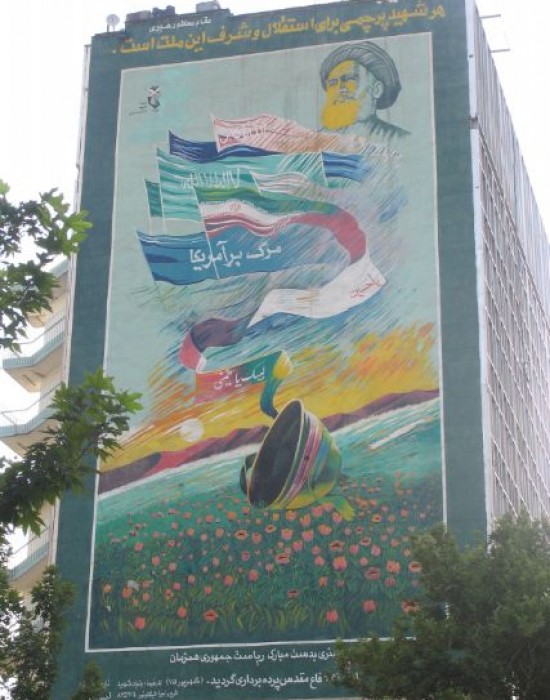

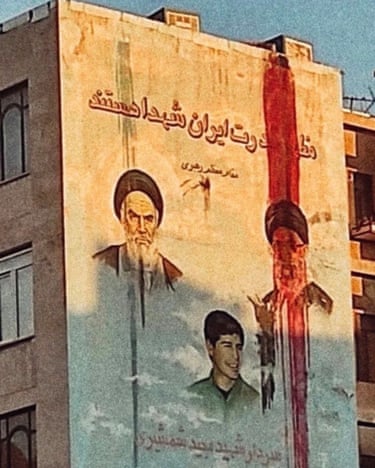
Tehran 2014: Photo credits: Shermin Voshmgir
Tehran 2014: Photo credits: Shermin Voshmgir
Tehran 2014: Photo credits: Shermin Voshmgir